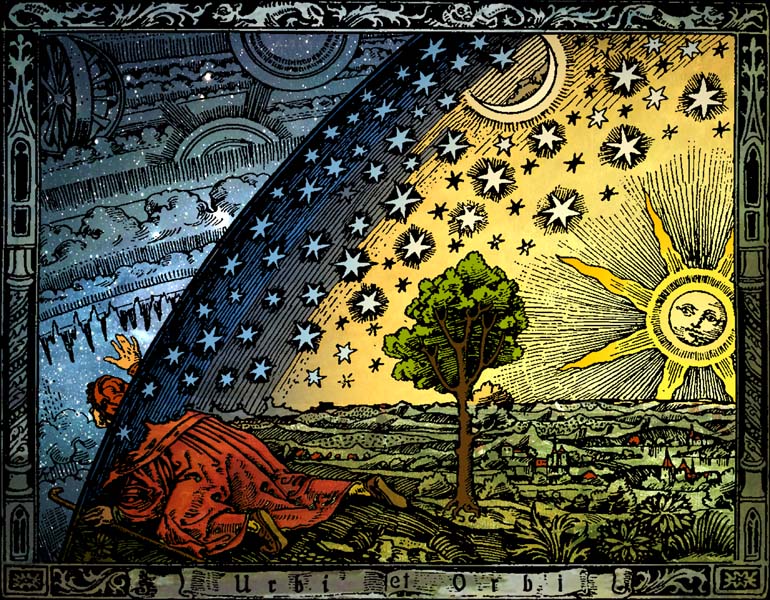
Thursday, February 26, 2009

I Should Really Post More Often


I have, once more, neglected to write anything for quite some time. I even found a paper from at least a week ago with various comments I gathered from my reading of the texts. At this point I doubt I'll understand them much but I want to take care of them as best as I can so as to be capable of moving on.

Yates
-Camillo's memory theatre drew from many ideologies as he attempted to contain the entire universe in his memory. He illustrated this goal with imagery of finding oneself within a forest and being unable to form a clear picture of the forest or one's place in it without climbing to the top of a high hill that overlooks it all. Yates quotes Camillo as saying, "in order to understand the things of the lower world it is necessary to ascend to superior things, from whence, looking down from on high, we may have a more certain knowledge of the inferior things."

-A memory system of this scale, particularly the seven parallel gates, is a systematized version of the traditional memory theatre we've seen before. Although Camillo deals with symbols and concepts I do not easily relate to, I would consider creating something like this for myelf for the purpose of exponentially expanding my capacity to remember. My current theatre works very linearly and simply. This is good for contained stories and lists. I would like to accomplish a more wikipedia-like memory system without simply complexifying each locus. How, precisely, i don't know yet.

-One last thought with this. Yates sums up Camillo's feat not simply as "a highly ornamental filing cabinet" but as an idea "the Idea of a memory organically geared to the universe." This brought to mind an image that has always fascinated me known as the "Flammarion woodcut" which I will not explain but have posted above.

Ong
-Print is imbued with a sense of closure, which is part of the reason I have trouble getting myself to write things down, yet can talk forever. I have "communication commitment issues" in that respect.

-The relationship of sounds and words and letters brings to mind waveform. Waveform is the most literal visual interpretation of sound (though it would be next to impossible to read and write with it). Most people are familiar with how it looks, the squiggly lines you see on music visualizers, and in some of our classes for film we had to edit these patterns. You have a general pattern (flat means silence, spike means a loud noise) but the more you zoom into it the more detailed it becomes. Words are rarely tidy little pieces like they are when printed, everything mushes and slurs together in waveform and reminds me of the early texts where the idea of spacing hadn't come up yet.
"My Book and Heart Shall Never Part"
-I borrowed this short film from Professor Sexson (which he and his wife, Lynda, created). Using fictional and nonfictional elements the film examines 18th-19th century children's books, their origins, and how they shaped our culture. I found the subject very intriguing, but what best pertains to our class at the moment is the educational nature of most of these books. Of particular note are the books that teach the alphabet through simple images and sayings "The Eagle's flight is out of sight" for the letter E, for example. Books like these were a natural transition between the letter and image memorization aids we see in Yates chapter five and our often less compelling modern works "A is for Apple, B is for Ball." Going along these lines and the common class theme of using grotesque imagery I invite you to read through Edward Gorey's "The Gashlycrumb Tinies" found here.

Wednesday, February 11, 2009

Ken, Kenning, Kennings

On Monday we learned the epithet "Keen Kenning Ben." I had just posted a blog on the word kenning and at first thought this was the same reference. It soon became apparent that they were different words and that our mutual use of these terms was purely coincidental. Therefore, I would like to write about kenning more thoroughly.

As used in the epithet, kenning seems to be a verb (to ken) meaning to know or perceive. Ben thus understands things keenly, or sharply. If there is another definition or understanding of the word I do not know it.

My use of kenning is a noun (a keening, many kennings). I found the term by looking up the phrase "whale-road" as mentioned in Ong as he discusses using formulaic language, though I think it is mentioned explicitly somewhere.

A kenning is a figurative expression used to substitute a noun. We get them from old Norse poetry, particularly from Beowulf. They can be phrases or compound words. Whale-road means sea, storm of swords means battle, sea steed means ship, bane of wood means fire, and so on. Kennings can even be used within other kennings: A raven is a war-gull, a feeder of ravens is a warrior, thus a warrior is a feeder of war-gulls.

A kenning is a circomlocution, a longer, more complicated way of saying something relatively simple, somewhat like riddles. Using a kenning rather than the literal word, further attention is drawn to the word, further thought invested than normal. Kennings are like epithets. They create memorable elements that can easily be used again and again, thus aiding the oral storyteller. Finally, most kennings create a visual that outweighs that of the literal word.

Sunday, February 8, 2009

Quote of My Day

"Where there is no narrative, there is no history."
-Bendetto Croce

In the Dark Backward and Abysm of Time

It has been far too long since my last post, yet this entire time I have been making notes as to what I'd like to talk about. With massive threads of interest I did what I always do, wrote them all down and tried to link them thematically, brainstorm style. This resulted in a very cluttered mess. So many of the topics blend with so many others that I really need a personal version of Wikipedia in order to sort through them all. Finally, though, I just need to start writing.

A little while ago in class we talked about being "spectators in our own skulls." This refers to the fact that no one sees truly from the perspective of anyone else. We tend to take for granted the fact that we have literally unique physical sensory experiences, the precise things "I" see, hear, etc. More so, we have individual thoughts, inner monologues, that nobody else can hear, though we must assume everyone else is as conscious of themselves as we are. Although the actual circumstances are vague, I remember a specific moment in childhood where I became aware that I could think inside my mind and thus became much more responsive to empathy. Everyone in the world lives an isolated life in this respect. We have no perfect way of knowing what another person is aware of, or even that they are aware. If all we have to go on is perception, how can we ever communicate love, hate, etc? Thus we must formulate from knowable imagery unknowable ideas.

Similar to this method of interpreting intangibles through physical means, the truth of stories is sometimes best received through less-than-true tales. A prime example of this is the film "Big Fish," which I strongly recommend watching. The point is, we all have knowledge, whether "true" facts or moral lessons, we wish to communicate to others so that they will remember them. As we continue to bring up in this course, as long as the essential truths stay firm, everything else can be entirely false. In fact, the more outlandish and bizarre the framing of the story, the more easily the story is recalled. Not only that, but describing something simple in a nontraditional way heightens our attention and invites reinterpretation. Similar to the epithet's we have discussed, kennings are strong recurring elements of story. Instead of fire say "bane of wood," instead of blood say "battle sweat," in this way even the most basic ideas are powerful.

A friend of mine asked why memories seem so much more emotionally charged than present experience. Like any story, the handful of things that keep a particular incident in mind in the first place are heightened as we draw in other references and remove unnecessary elements. That's not to say we simplify it infinitely. We don't remember being hit by a car and it hurt alot, we remember a person we had just spoken with, or a smell we noticed just before the incident. Insignificant details can become markers in the same way grotesque imagery does. Their inclusion in a story make the story legitimate, believable, even if other elements are impossibilities.

This leads me to cultural memory. Language is an organic, flowing link to the past. If you are reading this you understand written English, most likely you understand spoken English as well, which you learned from listening to others, who themselves listened to others, who listened to others still. You could potentially trace back a conversation (albeit a delayed one) from now to the dawn of language. You could also do the same thing between yourself and nearly anyone else on the planet. As far as history is concerned, this is my biggest interest. The connections that inevitably led to this moment, the way in which everything is connected whether we like it or not.

Connections and repetitions are fulfilling. In a film, there may be the huge twist at the end that makes the audience suddenly understand everything in a whole new light. There may also be something as simple as a subtle piece of music that is played and then much later under entirely different circumstances played again. Even if the audience is not paying attention to the score they will feel a link to the previous moment, and this will once more bring an element of interpretation that was not there before.

In class, the alethiometer from "His Dark Materials" was mentioned. Hopefully I do not spoil much (you've been warned) but it basically looks like a compass with a ring of small images instead of North, South, etc. The user can ask any question and can be told the answer through a spinning needle pointing at the objects. The objects are limited, but the answers are endless because any image has many levels of meaning. A cauldron could be literal, could mean cooking, could mean cooking up a plot, plans, etc. This is a perfect example of the storyteller's art. Yates mentions the memory treatises including long lists of objects (anvil, helmet, lantern) to be memorized and used in our memory palaces. Ong speaks of the recurrence of specific lines and epithets in Homeric poetry. Just like the images of the Alethiometer, there are limited elements but infinite applications. This is practical and simplifies a still impressive task when it comes to telling epics.

Recurring phrases and image inspire memory, we've covered this again and again. "The Divine Comedy" seems to exist less as a story of what the afterlife looks like, and more as a memory aid for virtues, vices, and the like. I wonder then, how we might apply these concepts to modern stories. I could definitely see a modern novel incorporating symbolic illustrations the way we see in medieval works. It would be similar to a text heavy picture book, only many of the images would not be literal. What I'm really interested in is the way this could be accomplished in movies.

Friday, January 23, 2009

Books to Look Into

The Alphabetization of the Popular Mind by Ivan Illich and Barry Sanders
Avatars of the World by James J. O'Donnell
The Brain that Changes Itself by Norman Doidge
The Castle of Crossed Destinies by Italo Calvino

I could not find The Oral Tradition of Common People

Thursday, January 22, 2009

Film and Language

I am a film student. and as we discuss the terrible nature of the written word I can only imagine what that means about movies. On the one hand, having video footage of fact or fiction may be considered an attack on the imagination of the viewer. Less thought process is needed to retain what is being told, thus retention of the idea is that much weaker. On the other hand, while it may still be a technology, we are circumventing the need to interpret the subtleties of the spoken word through the constraints of writing. In fact, we are circumventing the technology of the spoken word itself. Rather than try to capture a memory of an image in words, we are giving you the very thing to remember, though still unreal. Of course, films are based on scripts, but too much happens between the page and the movie theater to call them constrained by the text.

Of particular relevance to me is the television series by Jim Henson, "The Storyteller," it was a series based on the purest form of various fairy tales and myths. None of the tales were sugar coated or rationalized like we see so much nowadays. What's more, the show was framed around a man sitting before a fire and telling the stories to us, blended with scenes from within the stories themselves. Thus, we were given a feeling of the oral tradition while still making use of the medium to see the filmmakers' visual interpretations. As an interesting note, spoken stories are traditionally thought of being told in firelight, filmed stories are physically shown through projected light in a darkened room.

What fascinates me are the different ways in which a story may be told: first hand account (limited by one perspective), the oral telling, the written word, a documentary, a fictional adaptation, an original concept, or an interactive video game. Games can create an engagement similar to the imagination required when listening to a storyteller or reading a novel. However, this engagement is more hands on. The overall events and images are already in place, but it is up to the player to make it through. Many games focus on the entertainment value of racking up points, which is fine, but some try to go further. Many games let you customize your character and choose your path. The best of these have alternate endings to your story, thus blending the engagement of personal control with the scale of a preconceived plot. On the other end of the spectrum are games that have little free will (though enough to keep you involved) but intricate storylines that you discover as you go.

One of my favorite games of all time is "The Longest Journey." It is an adventure game, point-and-click. The actual gameplay is mostly wandering around, picking up objects, and figuring out where to use the objects. The story is on a large scale and involves your character traveling between worlds and interacting with many peoples. Along the way she accomplishes feats that fulfill prophecies but learns the stories of the prophecies as well. Much of the game involves long conversations, including a tribe devoted to storytelling, but that is what makes the game memorable. Every individual and culture has the same ideas , but reinterpreted to suit their unique circumstances.

To return to my original topic, I would link this game to Star Wars. When the final episode of the the prequel trilogy came out I watched the entire series as a whole. The moment that I found most fulfilling in those six movies is in the final film, "Return of the Jedi." After all the adventures that have taken place, C-3PO tells their story to the Ewoks by a fire, sound effects included. We, as the audience, are strongly connected to this activity because, while we were not making the decisions, we were there the entire time, emotionally participating in the story.

Word Drunk

I'd like to post some thoughts from class that I have not referenced when writing about the chapters.

-Word of the day for me:
Mellifluous: sweetly or smoothly flowing; sweet-sounding: a mellifluous voice; mellifluous tones.

-I find I am greatly interested in the flow of language. This can be in conversation (as mentioned in class) the way one topic changes, reflects on itself, broadens and focuses in over time. I once drove to California (from Idaho) with my sister and her friend. For about almost an hour I stopped participating in there conversation and instead, wrote down the subjects and how they evolved. What interested me is that the topics would blend and flow smoothly for a long time before suddenly changing with no apparent motivation for the tangent. Later on they would return to an earlier train of thought as if uninterrupted. Similarly, it is interesting when having a conversation with a friend how a very specific conversation point will occur and you realize that they told you the exact same thing days, weeks, or months ago. It's not just the subject matter but the angle and perspective from which it is approached.

Another flowing of language deals with larger stories. The Battle of Troy, King Arthur, and countless other tales began as "true" accounts told by witnesses. These would be retold, exaggerated, and re-examined countless times over generations. Certain elements would stick, others would not. Eventually we reach modern times and while different interpretations exist, we have come to know the essential stories (even though much of them are rather unlikely). Once again I turn to Joseph Campbell on this topic, who also brings up that had writing not become widespread, all of our stories would have evolved in a similar fashion. Many stories that seem hard to understand would have advanced along with us, adapted to suit our needs as a culture. Unfortunately this seems to have been lost due to writing as well as news media and increase in general knowledge throughout the world. While all of this seems like a vast game of Telephone, Campbell insists that the subconscious mind plays a major part in the evolution of a story. Perhaps with the right amount of added chaos, a game of telephone could result in something innovative.

Finally, and much more briefly as I have already written about this subject, spoken language itself flows. In distant human prehistory, certain sounds stuck and became words. As the capabilities increased, the need for specificity in communication increased as well. The way in which we pluralize, infer the past, or speak sarcastically gradually emerged. Dialects became standard languages, which subsequently broke into new dialects. Words were borrowed, reinterpreted, and forgotten. These days less and less people write freehand. The grammatical shortcuts of texting culture is affecting the spoken word. We are rapidly becoming oral again due to cell phones, webcams, and the like. Language has become international. As subcultural blends of the standard languages become more prevalent, perhaps we as a world will communicate easier. It may look as though we are speaking and writing poorly, but "Standard English" is simply another interiorized technology that may need to go.

Change is the norm, loosen up.